
Elk City, OK — A new satellite based detection program is already making a difference for fire departments across western Oklahoma.
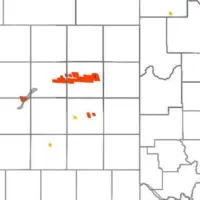
Elk City Fire Chief Kyle Chervenka and Carter Fire Chief Chad Rippetoe say the Next Generation Fire System recently helped crews respond quickly to multiple fires near Roll and Strong City in Roger Mills County.
“I think they’ve had it working for a little while, but they’re finally perfecting it and kind of releasing the alert system now,” Chervenka said. “It seems like the Forest Service is Johnny on the spot with calling these fires in, and Oklahoma Emergency Management is using it as well. It alerted them quick and they got there fast and caught them while they were small.”
The system uses satellite imagery, artificial intelligence, and other technology to detect heat signatures from fires on the ground. Once enough heat is detected, the system triggers an alert.
Chervenka said the program has even picked up local prescribed burns almost immediately after ignition.
“We’ve done some control burns and it’s triggered them pretty quick, almost about the time of ignition,” he said. “Once we start getting some heat on the ground, it’ll trigger a fire alert.”
Currently, alerts are routed through Oklahoma Emergency Management, but local departments can also monitor the system directly. Chervenka has a dedicated computer in his office that sounds an audible alarm when a fire is detected within a selected region.
“It makes a big loud noise whenever it detects a fire,” he said. “You can pinpoint it to your region where you want it to alert to. It’s not just the whole state or the whole country.”
The speed of the system was evident during a recent controlled burn in Carter. Chervenka received an alert and immediately texted Rippetoe.
“It popped up a fire real quick,” Chervenka said. “It was about time of ignition.”
Rippetoe explained the burn had already been communicated internally, but the call to dispatch had not yet been made.
“The guy that was doing the burning had called one of the guys to let him know, and he took a phone call literally between the phone calls,” Rippetoe said. “Kyle’s texting me like, ‘hey,’ and I was like, ‘yeah, we’ve got it on our group text. He just hadn’t got it called into dispatch.’”
Both chiefs say the system’s rapid detection could prove critical during high wind conditions, when wildfires can spread quickly across open land.
Looking ahead, the technology may become even more valuable. Chervenka said future upgrades discussed during a recent training class could integrate property tax data to identify nearby structures and assess risk levels automatically.
“In the future they’re hoping it will tell us what houses are around and kind of tell you where the biggest risk is,” he said. “If we’re going to fight a fire and we’re trying to size this thing up real quick, it will help guide us for structure protection.”
While departments currently rely on tools like drones to survey fire scenes, those tools have limitations, especially in severe weather.
“We have drones, they work pretty good,” Chervenka said. “But when you get 50 mile an hour wind, you may not get your drone back.”
With faster alerts and future enhancements on the horizon, local fire officials say the Next Generation Fire System is already proving to be a powerful tool in protecting lives and property across western Oklahoma.
Copyright 2025 Paragon Communications. All rights reserved. This material may not be published, broadcast, rewritten, or redistributed without permission.


